
More than five decades looking at the sky
The Guadalajara Aeroclub was officially founded in 1973 thanks to the initiative and enthusiasm of a group of aviation enthusiasts. Since then, more than five decades have passed in which the club has evolved alongside light aviation itself, always maintaining the same idea: bringing flight closer to all those people who feel curiosity and passion for the aeronautical world.
Our history is closely linked to some important names in Spanish aviation and to different stages that have marked the evolution of the Aeroclub until becoming the entity we know today.
The early years in Valbuena
The project's first steps took place at the estate of Colonel Rafael Borrás Tornay, a prominent test pilot for Hispano Aviación. There, the idea of creating a space dedicated to sport aviation began to take shape.
The inaugural event took place at that first rudimentary airstrip in Valbuena. In this first stage, the Aero Club was led by Lieutenant General Francisco Vives Camino, who became its first president.
His relationship with the Royal Aero Club of Spain was fundamental to promoting the first infrastructures and consolidating aeronautical activity.
The move to Robledillo
Over time, operations from Valbuena began to interfere with the approach routes of military aircraft from the Torrejón Air Base. This circumstance made it necessary to find a new location.
The solution was to move the airfield to Robledillo de Mohernando, where a new era for the Aeroclub began.
The acquisition of the land and the construction of new facilities made it possible to have hangars, training classrooms, and a suitable landing strip to continue developing aeronautical activity.
An era of expansion
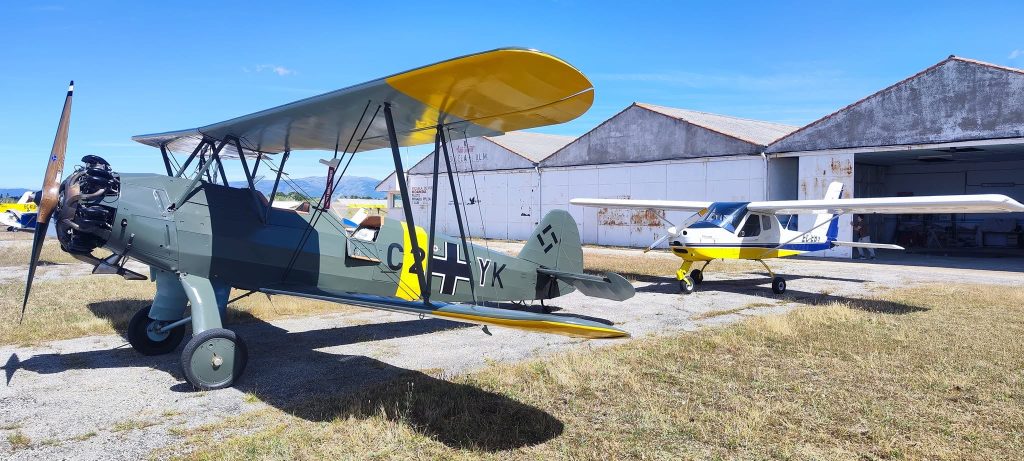
During the 1980s and 1990s, the Aero Club experienced a significant period of growth. The flight school trained numerous pilots using classic aircraft such as the AISA I-11B and the I-115.
The development of gliding, promoted by José Antonio Raya, was also of special importance, helping to introduce this modality to numerous young people.
During those years, the airfield also hosted large-scale projects, such as the Europlanet aviation school, founded by Jesús Muela Moratilla.
The project came to operate 17 training aircraft and made it possible to train more than 120 commercial pilots, many of whom later developed their professional careers in airlines around the world.
An eye on the future
Aviation has changed enormously since those early years. Operating costs, regulations, and the new needs of the sector have presented different challenges to the Aeroclub.
Far from stopping, the club has opted for modernization and innovation. The incorporation of electronic visibility systems, new training tools, and advanced simulators is part of this evolution.
Today, the Guadalajara Aeroclub continues working to bring aviation closer to the new generations and prepare for a new era marked by advanced ultralights, digitalization, and new aeronautical technologies.
More than 50 years after its founding, the spirit remains the same: sharing the passion for flying.